







































































































































































8 Daily Habits for Mental Clarity and Better Focus
Author: RVLNSV PRASAD
Updated On: September 2026
About Us
Author Bio
Editorial Policy
Contact Us

Introduction
Mental clarity is not about forcing your brain to work harder all day. It is often about removing the things that make clear thinking harder in the first place.
Poor sleep, constant notifications, prolonged sitting, stress, an overloaded to-do list, and frequent task switching can make an ordinary day feel mentally exhausting. At the same time, healthy routines can create better conditions for attention, memory, and everyday decision-making.
There is no single habit that works for everyone.
Instead, daily habits for mental clarity work best when they address different parts of your day, including sleep, movement, nutrition, attention, stress, and mental organization.
Current evidence supports several of these foundations. Regular physical activity can support thinking, mood, and sleep, while adequate sleep is important for brain function and memory. A balanced diet also provides the nutrients needed for overall health. (Mayo Clinic | CDC | WHO)
If you also want to work on the emotional side of healthy routines, see this practical guide to improving your mood with healthy habits. It complements the focus strategies discussed here by looking at sleep, movement, nutrition, social connection, and other everyday behaviors.
This guide takes a practical approach. Rather than promising instant results, it focuses on eight habits that are realistic for ordinary workdays, study days, and busy family life.
Quick Answer
The most useful habits for mental clarity include getting adequate sleep, moving regularly, reducing unnecessary digital distractions, working on one important task at a time, managing mental clutter, eating a balanced diet, practicing mindfulness or slow breathing, and taking purposeful recovery breaks.
You do not need to adopt all eight at once. Start with one or two habits that address your biggest problem.
If concentration or memory problems are persistent, worsening or interfering significantly with everyday life, lifestyle changes should not be used as a substitute for medical evaluation.
Key Takeaways
- Sleep is one of the foundations of clear thinking and attention.
- Physical activity can support cognitive health, mood, and sleep.
- Constant digital interruptions can make focused work harder.
- Single-tasking can make demanding work more manageable.
- Writing down unfinished thoughts can reduce the mental burden of remembering everything.
- A balanced diet is more useful than chasing individual “brain foods.”
- Mindfulness may support some aspects of attention and cognitive functioning, but results vary.
- Short breaks should help you recover rather than become another long distraction.
- You do not need a perfect routine. A repeatable routine is more useful.
- Persistent cognitive or concentration changes deserve appropriate medical attention.
What Does Mental Clarity Actually Mean?
Mental clarity is not a formal medical diagnosis.
In everyday language, people usually use the term to describe the ability to concentrate, organize thoughts, remember information, make decisions, and stay mentally present.
You may notice the opposite when your mind feels overloaded.
For example, you might read the same paragraph several times, forget why you opened your phone, jump between unfinished tasks, or struggle to decide what deserves your attention first.
These experiences can have many possible causes. Poor sleep, stress, anxiety, medication effects, and certain medical conditions can all influence concentration.
That is why I prefer to think about mental clarity as a daily environment for the brain, rather than a problem that can be fixed with one supplement or one “brain-boosting” food.
8 Daily Habits for Mental Clarity and Better Focus
1. Protect Your First Focus Period From Unnecessary Notifications
Many people begin the morning by checking messages, social media, email, and news.
The problem is not that phones are automatically harmful. The problem is that they can immediately divide your attention between several competing sources of information.
A more practical approach is to create a phone-light first period.
You do not necessarily need to avoid your phone for an exact 30 minutes. Instead, decide what genuinely needs your attention when you wake up.
For example:
- Drink water.
- Get ready for the day.
- Open the curtains or step outside.
- Think about your most important task.
- Write down three priorities.
- Check urgent messages only when necessary.
The goal is not to create another rigid wellness rule.
It is to prevent your first few minutes from becoming a stream of unrelated information.
Digital habits can also affect mental clarity indirectly through sleep. A large systematic review and meta-analysis involving more than 41,000 participants found an association between electronic media use and poorer sleep quality and sleep problems. (PubMed)
People-first tip: If you need your phone for work, family, or emergencies, do not force a complete phone ban. Turn off nonessential notifications instead.
2. Make Sleep a Non-Negotiable Part of Your Focus Strategy
Trying to improve concentration while consistently sleeping poorly is like trying to drive with an almost empty fuel tank.
Sleep supports normal brain function, memory, and alertness. Mayo Clinic’s current brain-health guidance recommends that adults generally aim for 7 to 9 hours of sleep each night. (Mayo Clinic)
Sleep also affects how you feel during the day. If poor sleep is accompanied by stress or low mood, it can be useful to look at your overall daily routine rather than treating sleep as an isolated habit. You can also explore these healthy daily habits for stress reduction for practical ways to create a calmer routine.
A practical sleep routine may include:
- Keeping a reasonably consistent bedtime.
- Waking at a consistent time when practical.
- Limiting stimulating activities close to bedtime.
- Keeping the bedroom comfortable and dark.
- Addressing persistent snoring or suspected sleep problems.
- Avoiding the habit of using your bed as a place for prolonged work.
You do not need to achieve perfect sleep every night.
The objective is to make adequate sleep a regular part of your lifestyle.
Try this tonight: Instead of asking, “How can I become more focused tomorrow?” ask, “What can I do tonight that makes tomorrow’s brain function easier?”
3. Move Your Body Every Day
Physical activity deserves a prominent place in discussions about mental clarity.
It does not have to mean a gym workout.
Walking, cycling, dancing, resistance exercise, swimming, yoga, and active household work can all contribute to physical activity.
The CDC states that physical activity can support brain health, thinking, learning, memory, and emotional well-being. It also notes that adults who sit less and perform any amount of moderate-to-vigorous activity can gain health benefits. (CDC)
Yoga can also be a practical option for people who prefer a lower-impact mind-body activity. If you want to explore how yoga can fit into a broader wellness routine, see 9 Benefits of Yoga for Holistic Health and Well-Being.
Research also supports a broader connection between exercise and cognition. A large 2025 umbrella review examined 133 systematic reviews covering more than 258,000 participants and found associations between exercise and improvements in general cognition, memory, and executive function, although effects varied between outcomes and populations. (PubMed)
That distinction is important.
Exercise should not be marketed as a guaranteed instant “brain booster.”
Instead, think of movement as part of a broader lifestyle that supports physical health, mood, sleep, and potentially cognitive function.
Easy starting point: Take a 10-minute walk after one meal.
If you are already active, gradually build toward the level appropriate for you. CDC guidance notes that adults can work toward at least 150 minutes of moderate-intensity activity per week, while smaller amounts can still provide benefits. (CDC)
4. Practice Slow, Comfortable Breathing When Your Mind Feels Overloaded
Sometimes the problem is not a lack of ability to concentrate.
You may simply be carrying too much tension into the task at hand.
A few minutes of slow, comfortable breathing can become a transition between stress and focused work.
Try this simple version:
- Sit comfortably.
- Relax your shoulders.
- Breathe gently through your nose if comfortable.
- Let the exhalation feel relaxed rather than forced.
- Continue for two to five minutes.
- Return to your task.
You do not need to take extremely deep breaths or hold your breath for long periods.
The purpose is to create a short pause.
This can be especially useful before:
- An important meeting
- Studying
- Writing
- A difficult conversation
- Driving
- Returning to work after an interruption
If stress is one of the main reasons your mind feels crowded, you may also find it useful to explore these natural ways to reduce anxiety and stress in daily life.
A useful mindset: Do not use breathing as a promise that you will “fix” your brain in five minutes. Use it as a way to create a calmer transition into the next activity.
5. Stop Asking Your Brain to Do Five Things at Once
Multitasking often feels productive because several things are happening simultaneously.
But mentally demanding activities can compete for attention.
Imagine trying to write an article while answering WhatsApp messages, checking email, watching a video, and reading news.
You may spend more time restarting tasks than actually completing them.
A better approach is single-tasking in short blocks.
Choose one task.
Remove obvious distractions.
Work until a natural stopping point.
Then move to the next task.
Try the “One Important Task” Rule.
At the beginning of a work session, ask:
What is the one thing I most need to finish?
Write it down.
Then work on that task before moving to less important activities when possible.
This is not about ignoring urgent responsibilities.
It is about preventing every task from competing for equal attention.
People-first insight: You do not need an elaborate productivity system. Sometimes simply writing one priority on paper is enough to make the next step obvious.
6. Reduce Mental Clutter by Getting Unfinished Thoughts Out of Your Head
This is one of the simplest habits I would add to a mental-clarity article.
Your brain should not have to remember every unfinished task.
If you keep thinking:
“I need to call someone.”
“I need to pay that bill.”
“I must finish that report.”
“I need to buy something.”
“I should remember to send that email.”
your attention is repeatedly pulled toward those unfinished items.
Instead, create a mental clutter list.
Keep a notebook or digital note nearby.
Whenever an unrelated task appears during focused work, write it down.
Then return to the main task.
For example:
Mental clutter list
- Call the bank
- Buy groceries
- Reply to email
- Schedule appointment
- Check website update
The list does not solve those tasks.
It simply gives your brain a place to store them temporarily.
If mental clutter is closely connected with worry or anxiety, the broader strategies in 7 Natural Ways to Reduce Anxiety and Stress Daily can complement this approach.
Try the 3-Question Evening Reset.
At the end of the day, ask:
What did I finish?
What still needs attention?
What is the first important task tomorrow?
This can help create a clear stopping point between today’s unfinished work and tomorrow’s priorities.
It is a practical way to support mental organization without turning your evening into another productivity project.
7. Eat a Balanced Diet Instead of Chasing “Brain Foods”
There is a huge market for foods and supplements promoted as ways to improve focus.
But your brain does not require one magical ingredient.
Overall dietary quality matters more.
WHO recommends a varied diet that includes foods such as whole grains, vegetables, fruit, legumes, and nuts while limiting excess free sugars, salt, and unhealthy fats. (WHO)
For Indian readers, this can be adapted easily.
| Meal component | Everyday examples |
|---|---|
| Protein | Dal, beans, chickpeas, eggs, curd, paneer, fish, or tofu |
| Whole or minimally refined carbohydrate | Oats, whole-wheat roti, brown rice, millets, or other whole grains |
| Vegetables | Spinach, carrots, beans, gourds, tomatoes, cauliflower, and seasonal vegetables |
| Fruit | Banana, apple, guava, orange, papaya, or seasonal fruit |
| Healthy fats | Nuts, seeds, and appropriate amounts of plant oils |
WHO India similarly describes healthy eating around a variety of foods, including staple foods, legumes, vegetables, fruit, and appropriate animal-source foods, while noting that dietary needs vary with individual circumstances and local food customs. (WHO India)
A balanced diet can also support broader emotional well-being. Readers interested in the connection between everyday lifestyle choices and mood can continue with How to Improve Your Mood with Healthy Habits.
The Better “Brain Food” Question
Instead of asking:
“Which food will make me smarter?”
ask:
“Does my everyday diet provide enough variety and nutritious foods?”
That question leads to a much more sustainable strategy.
Do Not Forget Hydration
If you are thirsty, especially during a hot day or after physical activity, drinking enough fluid is sensible.
But avoid turning hydration into another exaggerated promise.
You do not need to drink extreme amounts of water to achieve mental clarity.
8. Practice Mindfulness to Train Your Attention
Mindfulness involves deliberately paying attention to present-moment experiences rather than automatically following every thought.
A simple practice can take five minutes.
Sit comfortably.
Notice your breathing.
When your mind wanders, recognize that it has wandered.
Then gently return your attention to the breath.
That return is part of the practice.
You do not need to empty your mind.
In fact, trying to eliminate every thought can make meditation frustrating.
If you want additional practical techniques, you can explore 6 Mindfulness Practices for Mental Well-being, which naturally expands on mindfulness-based approaches without requiring a complicated routine.
Research is encouraging but nuanced. A meta-analysis of 111 randomized controlled trials involving 9,538 participants found small-to-moderate effects from mindfulness-based interventions on several cognitive outcomes, including executive attention, working memory accuracy, and sustained attention. However, not every cognitive outcome improved. (PubMed)
Another meta-analysis found more limited effects, with a small improvement in executive function but non-significant results for several other cognitive domains. (PubMed)
So mindfulness may be useful, but it should not be presented as a guaranteed cure for poor concentration.
Begin with five minutes.
If that feels uncomfortable, try one minute.
Consistency matters more than making the session long.
The Mental Clarity Problem-Solving Table
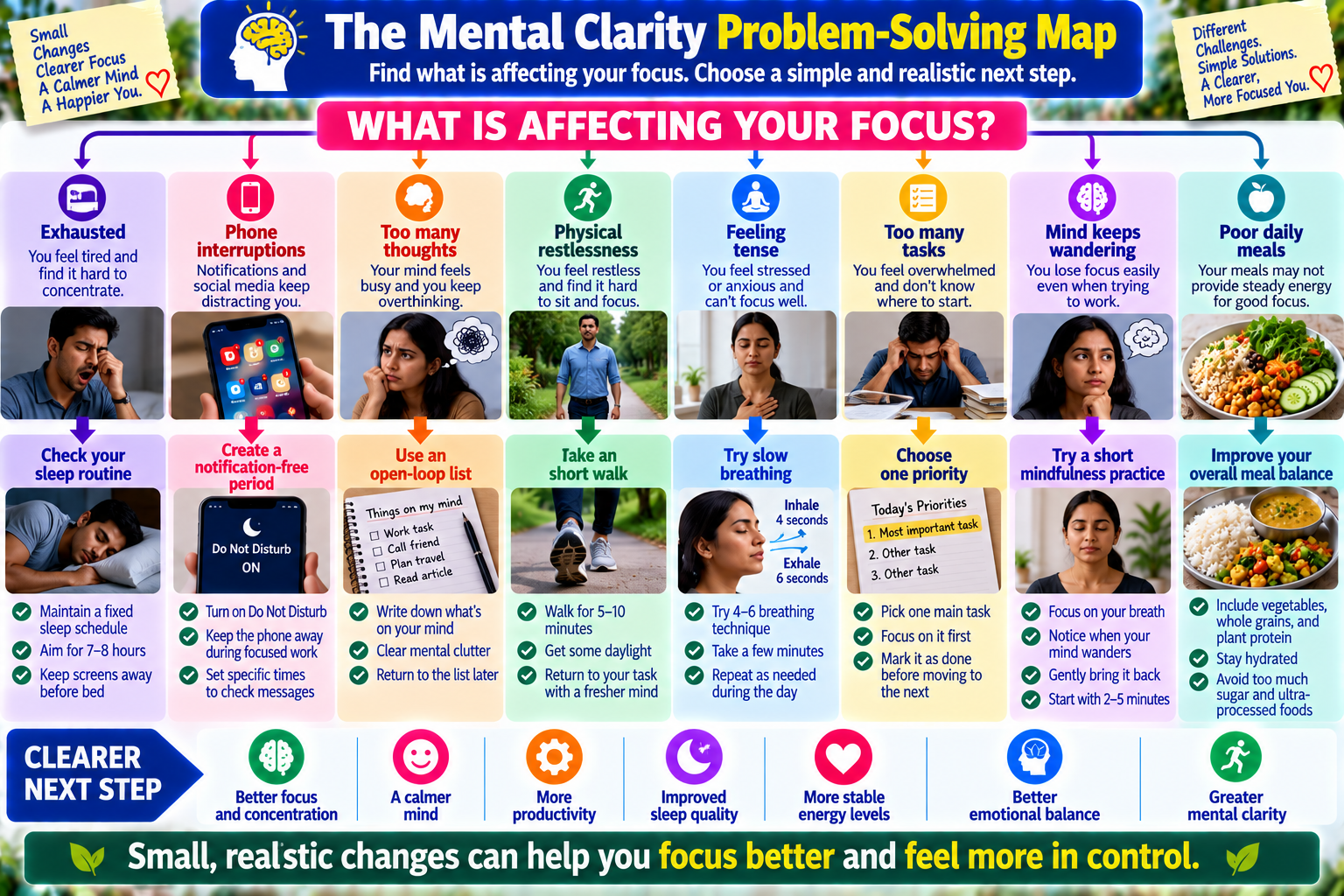
One useful way to apply these habits is to match the habit to the problem.
| What you notice | First habit to try |
|---|---|
| You are exhausted. | Review your sleep. |
| You feel physically restless. | Take a short walk. |
| Your phone keeps interrupting you. | Silence nonessential notifications |
| Too many tasks are competing. | Write one priority. |
| Thoughts keep jumping around. | Use a mental clutter list. |
| You feel tense before working. | Try slow breathing. |
| You cannot stay present. | Try a short mindfulness practice. |
| Meals are irregular or heavily processed. | Improve overall meal quality. |
| You have been sitting for hours. | Stand, stretch, or walk. |
| Your focus collapses late at night. | Protect your sleep routine. |
This is more realistic than telling everyone to follow exactly the same morning routine.
A Simple Daily Routine for Mental Clarity
You do not need to transform your entire lifestyle.
Try this example.
Morning
Wake at a reasonably consistent time.
Avoid immediately entering a stream of notifications if your responsibilities allow.
Drink water and eat a balanced breakfast if you normally eat in the morning.
Write down your most important task.
Midday
Move your body.
A short walk can interrupt prolonged sitting.
Eat a balanced meal containing protein, vegetables or fruit and a suitable carbohydrate source.
Return to one important task rather than constantly switching.
Afternoon
If your attention starts falling, take a short recovery break.
Stand up.
Walk.
Look away from your screen.
Then return to work.
Evening
Finish the most important unfinished tasks.
Write tomorrow’s priorities.
Reduce unnecessary digital stimulation.
Use a relaxing activity that does not keep your mind constantly engaged.
For additional ideas on creating sustainable routines around stress and recovery, see Healthy Daily Habits for Stress Reduction.
Night
Protect enough time for sleep.
Aim for the 7–9-hour range recommended for most adults. (Mayo Clinic)
If persistent snoring, insomnia, excessive daytime sleepiness, or another sleep problem is interfering with your rest, consider discussing it with a healthcare professional.
A Unique Habit: Create a “Clarity Window”
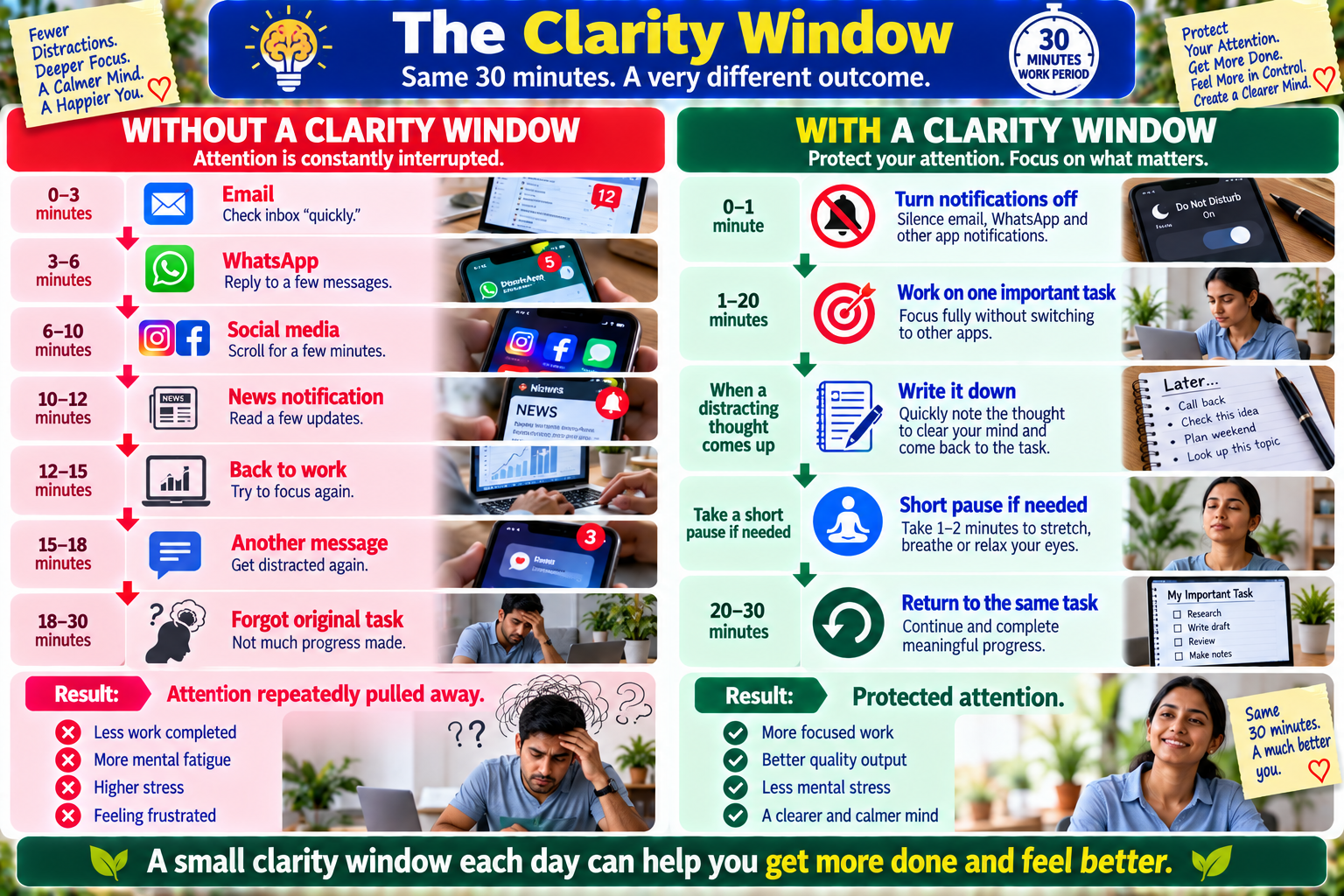
One practical idea that is often missing from generic mental-clarity articles is a Clarity Window.
Choose 20–30 minutes during your day when you deliberately remove unnecessary input.
During this period:
- No social media
- No unnecessary messages
- No news
- One task only
- A quiet environment
- Phone notifications disabled
- Notebook available for distracting thoughts
The purpose is not to work harder.
It is to give your attention a protected space.
For someone who spends much of the day switching between apps and messages, this may be more realistic than trying to completely eliminate technology.
Another Simple Strategy: The “Open Loop” List
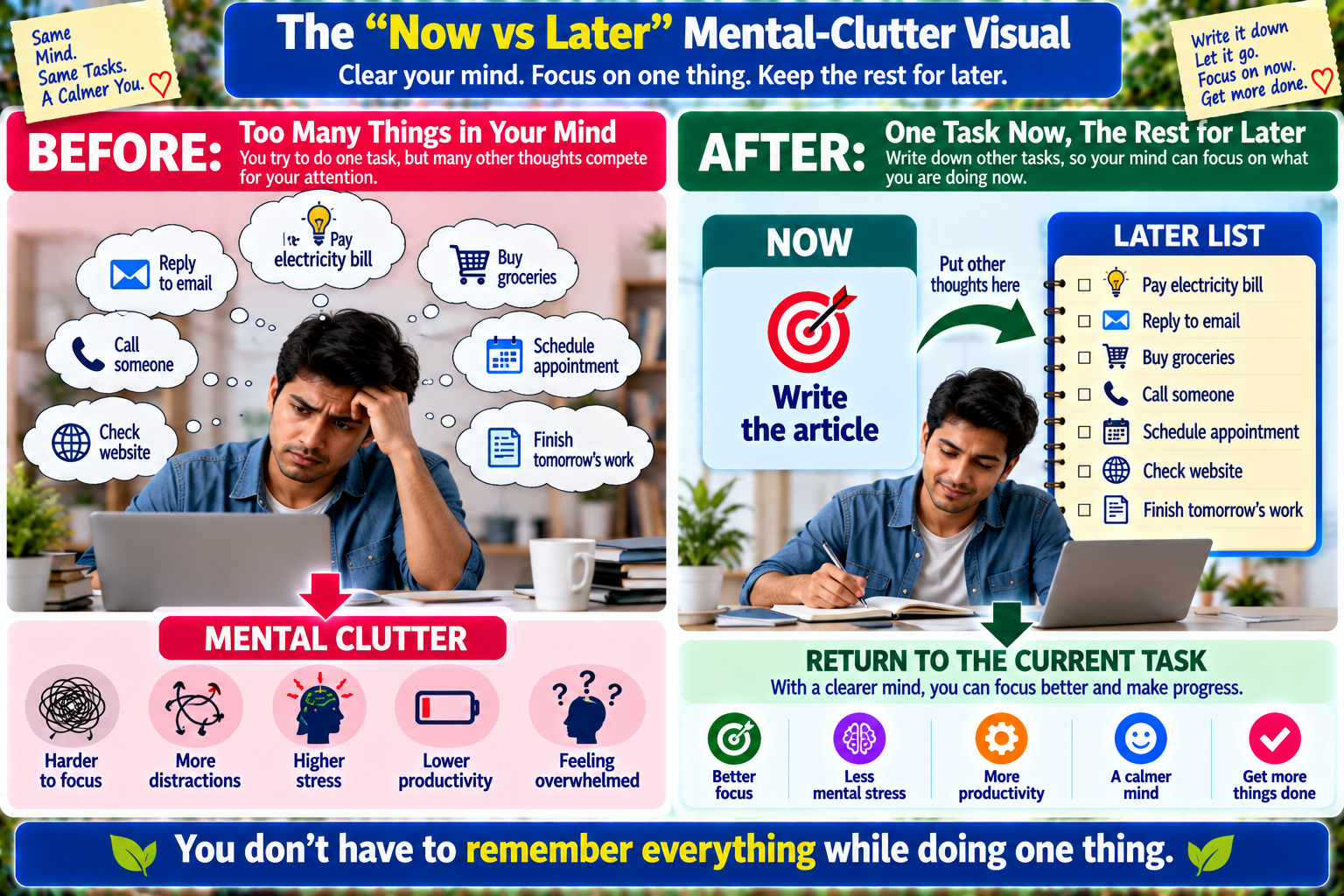
Mental clutter often comes from unfinished things.
Before starting concentrated work, write down anything you are worried you might forget.
Then begin.
If another thought appears, add it to the list instead of immediately acting on it.
This creates a simple distinction:
Now: the task in front of you.
Later: everything else.
That separation can make a busy day feel more manageable.
Personal Experience
There was a period when I found it difficult to maintain concentration for long periods.
I noticed that the problem was not always the difficulty of the work itself. Sometimes my attention was already divided before I started.
Phone notifications, unfinished tasks, and irregular routines made it harder to settle into one activity.
I began making smaller changes instead of trying to redesign my entire day.
I reduced unnecessary phone use during focused work, paid more attention to sleep, and started organizing unfinished tasks before moving to the next activity.
The important lesson for me was not that one habit suddenly transformed everything.
It was that small changes reduced friction.
That is the approach I recommend here as well.
Your experience may be different.
If concentration problems persist despite reasonable lifestyle changes, do not assume that you simply need more discipline.
Common Mistakes That Can Make Mental Clarity Harder
Trying to Change Everything on Monday
Starting eight habits simultaneously can create another source of stress.
Choose one or two.
Build from there.
Chasing Supplements Before Fixing Sleep
Supplements are often marketed as quick solutions for focus.
But sleep, physical activity, nutrition, and stress management deserve attention first.
Mayo Clinic’s brain-health recommendations emphasize broad lifestyle factors such as sleep, physical activity, and healthy eating rather than relying on one “brain booster.” (Mayo Clinic)
Confusing Busyness With Productivity
A full calendar does not necessarily mean meaningful progress.
Sometimes completing one important task is more valuable than touching ten tasks for five minutes each.
Using Breaks as Another Screen Session
If your “break” becomes 25 minutes of social media, your brain may not receive the recovery you intended.
Try walking, stretching, getting some fresh air, or simply stepping away from the workstation.
Expecting Instant Results
Some habits may affect how you feel quickly.
Longer-term changes are different.
Research does not support a universal timeline such as “everyone will notice better mental clarity within two weeks.”
Your response depends on the habit, baseline health, sleep, stress, consistency, and other factors.
Latest Research Developments: What the Evidence Says in 2026
Research on mental clarity is moving away from the idea that there is one simple “brain-boosting” intervention.
Several themes are becoming clearer.
Exercise Has a Stronger Evidence Base Than Many “Brain Hacks”
A 2025 umbrella review examined 133 systematic reviews covering thousands of randomized controlled trials and more than 258,000 participants. Exercise was associated with improvements in general cognition, memory, and executive function. (PubMed)
At the same time, newer research shows that not every form or duration of exercise produces the same cognitive outcome.
A 2026 meta-analysis of aerobic exercise trials found stronger evidence for mood benefits than for immediate cognitive improvements in healthy adults. (PubMed)
That is a useful reminder to avoid exaggerated “exercise instantly makes you smarter” claims.
Sleep Remains a Major Part of Brain Health
Mayo Clinic continues to include adequate sleep among its major brain-health recommendations, with 7–9 hours suggested for adults. (Mayo Clinic)
Sleep research continues to investigate how sleep duration and quality relate to cognitive outcomes, which supports treating sleep as part of a broader brain-health strategy rather than simply a recovery period.
Mindfulness Shows Potential, But It Is Not a Magic Solution
The large meta-analysis of 111 randomized controlled trials found benefits across several cognitive measures, but not all outcomes improved. (PubMed)
Another meta-analysis reported more limited effects, with a small improvement in executive function but non-significant results for several other cognitive domains. (PubMed)
This difference between reviews is exactly why responsible health writing should use language such as “may help” rather than promising dramatic cognitive improvement.
Digital Habits Matter Indirectly Too
A large systematic review found associations between electronic media use and poorer sleep quality. (PubMed)
This suggests an important practical point.
You do not necessarily need to eliminate your phone.
You may need to create boundaries around when and how you use it, particularly when it interferes with sleep or focused work.
Nutrition Research Supports Overall Dietary Quality
WHO continues to recommend dietary patterns emphasizing vegetables, fruits, legumes, nuts and whole grains, while limiting excessive free sugars, salt, and unhealthy fats. (WHO)
This supports a broader approach to brain-friendly eating rather than promoting one particular food as a mental-clarity cure.
A 7-Day Mental Clarity Starter Plan
| Day | Main habit | Small action |
|---|---|---|
| Day 1 | Digital boundaries | Silence nonessential notifications |
| Day 2 | Sleep | Set a consistent bedtime target. |
| Day 3 | Movement | Take a 10-minute walk. |
| Day 4 | Single-tasking | Complete one task without switching. |
| Day 5 | Mental clutter | Start an open-loop list. |
| Day 6 | Nutrition | Add vegetables, fruit, or legumes to a meal. |
| Day 7 | Mindfulness | Practice five minutes of mindful breathing. |
Do not treat this as a seven-day cure.
The purpose is to discover which habits fit naturally into your life.
When Poor Mental Clarity Should Not Be Treated as a Lifestyle Problem
Occasional forgetfulness or distraction is common.
Persistent or significant changes deserve more attention.
Consider speaking with a healthcare professional if you experience:
- sudden confusion
- rapidly worsening memory problems
- major changes in concentration
- severe daytime sleepiness
- persistent sleep problems
- symptoms of depression or severe anxiety
- headaches or neurological symptoms alongside cognitive changes
- concentration problems that significantly interfere with work, study, or daily activities
Do not assume that every concentration problem means you need a better productivity system.
Sometimes there is an underlying health issue that needs evaluation.
Frequently Asked Questions
What are the best daily habits for mental clarity?
Useful habits include adequate sleep, regular physical activity, reducing unnecessary digital distractions, single-tasking, managing mental clutter, eating a balanced diet, practicing mindfulness, and taking purposeful breaks.
What is the fastest way to improve focus naturally?
There is no universally fastest method. A practical first step is to remove immediate distractions, choose one task, and work on it without switching. If you are tired, improving sleep may be more important than another productivity technique.
Can exercise improve mental clarity?
Physical activity supports brain health, mood, and sleep, and research has found associations with cognitive benefits. However, the effects vary by exercise type, duration, population, and outcome. (CDC)
Does sleep affect concentration?
Yes. Adequate sleep supports alertness, memory, and normal brain function. Adults generally need around 7–9 hours of sleep per night. (Mayo Clinic)
Can mindfulness improve concentration?
Mindfulness-based interventions have shown benefits across some cognitive measures, although results are not consistent across every aspect of cognition. (PubMed)
For readers who want practical ways to begin, 6 Mindfulness Practices for Mental Well-being provides a natural internal next step.
Can food improve mental clarity?
A healthy diet supports overall health and provides essential nutrients. Rather than relying on one “brain food,” focus on dietary variety that includes vegetables, fruit, legumes, whole grains, and nuts where appropriate. (WHO)
How long does it take to improve mental clarity?
There is no reliable universal timeline. Some lifestyle changes can influence how you feel relatively quickly, while others require consistent practice. Avoid claims that everyone will experience a specific improvement within a fixed number of days.
Is mental fog always caused by stress?
No. Stress can affect concentration, but persistent cognitive symptoms can have many possible causes. If symptoms are significant or worsening, medical evaluation may be appropriate.
Simple Mental Clarity Checklist
Before finishing the day, ask yourself:
☐ Did I get enough sleep opportunities?
☐ Did I move my body?
☐ Did I spend too much time switching between tasks?
☐ Did I allow notifications to interrupt important work?
☐ Did I eat a reasonably balanced diet?
☐ Did I write down unfinished tasks?
☐ Did I take a genuine recovery break?
☐ Did I give myself a few quiet minutes?
☐ Did I choose tomorrow’s most important task?
You do not need nine checkmarks every day.
The checklist is there to help you identify patterns.
Author Note
I believe useful health content should make healthy choices easier rather than make readers feel guilty about imperfect routines.
Mental clarity is not about being productive every minute.
A person may have a demanding job, children, household responsibilities, financial pressure, or health challenges. A realistic habit must fit into that person’s actual life.
That is why this article focuses on small actions that can be adapted rather than rigid rules.
The evidence also matters.
Where research is strong, I have described it directly. Where evidence is mixed, I have avoided presenting the habit as a guaranteed solution.
Medical Disclaimer
This article is for general educational purposes and is not a substitute for medical diagnosis, treatment, or individualized advice.
Mental fog, memory problems, fatigue, and difficulty concentrating can have many possible causes. If symptoms are persistent, severe, sudden, or interfering with daily activities, consult a qualified healthcare professional.
Do not stop prescription medicines or change treatment because of information in this article.
Fitness Disclaimer
Physical activity should be adapted to your current fitness level, age, health conditions, and physical limitations.
You do not need intense exercise to benefit from movement. If you have a medical condition, significant pain, dizziness, chest symptoms, or other concerns during exercise, seek appropriate medical guidance before continuing.
Research Methodology
This article was updated using current information from major health organizations and peer-reviewed research, including Mayo Clinic, CDC, WHO, and PubMed-indexed systematic reviews and meta-analyses.
Priority was given to systematic reviews, meta-analyses, randomized controlled trials, and established health organizations where available.
Because research on cognition, mindfulness, digital behavior, and lifestyle interventions continues to evolve, individual studies should not be interpreted as proof that one habit will produce the same result for everyone.
Final Thoughts
Daily habits for mental clarity do not need to be complicated.
The most useful approach is to build an environment in which your brain has fewer unnecessary demands and more consistent support.
Start with sleep if you are exhausted.
Choose movement if you have been sitting all day.
Create a distraction-free period if your phone constantly pulls your attention away.
Write down unfinished tasks if your mind feels crowded.
Use slow breathing when stress is interfering with concentration.
Eat a varied, balanced diet instead of searching for one miracle brain food.
Practice mindfulness if you want to develop greater awareness of where your attention goes.
You can also explore the related guides on healthy habits for improving mood, stress-reducing daily habits, yoga for holistic well-being, and natural approaches to reducing daily anxiety and stress.
Most importantly, do not turn mental clarity into another reason to criticize yourself.
A productive day will not always be possible.
A clear mind does not mean having no distracting thoughts, no stress, and no difficult days.
It means creating simple habits that help you return to what matters.
That is a much more realistic goal—and one you can continue building long after the motivation of a new routine disappears.
Sources
- Mayo Clinic — 8 Tips for Better Brain Health
- CDC — Benefits of Physical Activity
- CDC—Physical Activity Boosts Brain Health
- CDC — Health Benefits of Physical Activity for Adults
- WHO—Healthy Diet
- WHO India — Healthy Diet
- PubMed—Exercise, Cognition, Memory, and Executive Function Umbrella Review
- PubMed — Mindfulness and Cognitive Function Meta-analysis
- PubMed — Mindfulness-Based Intervention and Cognitive Function Meta-analysis
- PubMed — Electronic Media Use and Sleep Meta-analysis
Related Content
- Home
- Cate Gory Healthy Habits
- 9 Benefits of Yoga for Holistic Health and Well-Being
- 4 Week Diet Plan for Weight Loss
- How to Improve Your Mood with Healthy Habits: A Comprehensive Guide
- Healthy Daily Habits for Stress Reduction: A Comprehensive Guide








[…] 8 Effective Habits to Boost Mental Clarity and Focus […]
[…] 8 Effective Habits to Boost Mental Clarity and Focus […]
[…] 8 Effective Habits to Boost Mental Clarity and Focus […]